Access

- Submit your institution’s Sharing Information on Progress (SIP) Report
- Access SIP reporting across institutions

Access
Access


 New York, United States
Share


In the Decade of Action towards Agenda 2030: The Power of Transformative Talk in Management Education
Dear Friends of PRME,
Calling for accelerating solutions to the world’s grand challenges, the UN Secretary General Guterres labelled 2020-2030 ‘The Decade of Action’. Global and local action is urgently needed to secure greater leadership, more resources, and innovative ways of addressing the Sustainable Development Goals. Budgets, policies and regulatory frameworks need to be adjusted to transform local and global action towards a more just, clean and equitable society.
No doubt there is an urgent need for transformative action to create the world we need. And no doubt that management education holds a huge responsibility to create that action. But in this call for a ‘Decade of Action’, the need for talk and communication gets somewhat under-appreciated. There is an implicit assumption that ‘action’ is superior to ‘talk’.
However, as management educators we know that talk is action too. Talking is an important part of the job. Drawing on linguistic philosophy and speech act theory, management scholarship has long ago established how ‘talk’ not only represents reality but makes reality. Communication does things. One classic example is the ‘yes’ uttered in the church by the bride and the groom. After this ‘yes’ has been stated in public, the relationship is forever changed between these two people. Another classic example is the statement: ‘I name this ship ‘Queen Elizabeth’. The statement is not describing the launching ceremony but doing it (Austin, 1962). Just think about those talks that have influenced the behaviors of the world and still do such as Martin Luther King’s ‘I have a Dream’ in 1963 and John F. Kennedy’s presidential inaugural address in 1961. And just think about types of small daily communications such as apologizing, requesting, complaining, warning, inviting, refusing and congratulating. These are communicative actions that do things and change the relation between people, sometimes radically influencing their behaviors accordingly.
In management performativity studies and CCO theorizing (Communication Constitutes Organization) ‘talk’ is accordingly analyzed as action. These theories draw on the basic idea that every use of language carries a performative dimension: ‘to say something is to do something’. Here the role of communication is the core subject of study in trying to understand better how language is used to mobilize those needed resources to achieve the SDGs, to give more attention to uncomfortable climate truths, to surface taboo issues on inequities – all with an ambition to create positive transformative action.
In fact, the SDGs themselves emerged after a lot of talk. The successful creation of the SDGs was created out of several years of talk involving 193 UN member states as well as businesses, civil society and international organizations. Today, this communication is one of the UNs most recent impactful inventions that has changed the orientation, engaged new debates, and systematically transformed behavior around the world.
At the same time ‘talk’ is belittled, degraded, and looked down upon. In the Trump era, talk was increasingly deprecated as being hot air, deceit, or fake news. How often do we not hear such statements as ‘action speaks louder than words’, ‘pay less attention to what men say, just watch what they do’, or ‘it doesn’t mean anything, it is just talk’.
While that may very well be the case some of the time, it is also worth considering that the relationship between talk and action is oftentimes somewhat more complex than that. Talk is also performative for action.
As educators in management schools, we talk a lot. We know that talk matters. And in fact, we believe that this talk is an impactful part of our mission, that serves to transform the behavior of the leaders of the world. So, while we are urgently focused on changing the action towards Agenda 2030, let us not forget to also celebrate the transformative power of talk.
Warm regards,
Mette Morsing
Head of PRME, PRME Principles for Responsible Management Education
UN Global Compact
New York
Reference:
Austin, John L. 1962. How to Do Things with Words. Oxford: Oxford University Press.
Share
New York, United States
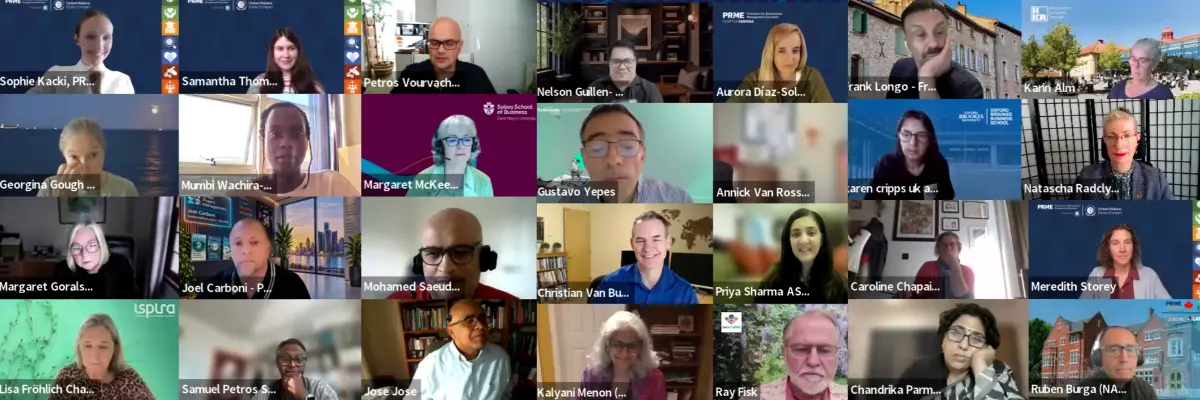
14 Regions Reunite for PRME’s 7th Annual Global Chapter Forum
 New York, United States
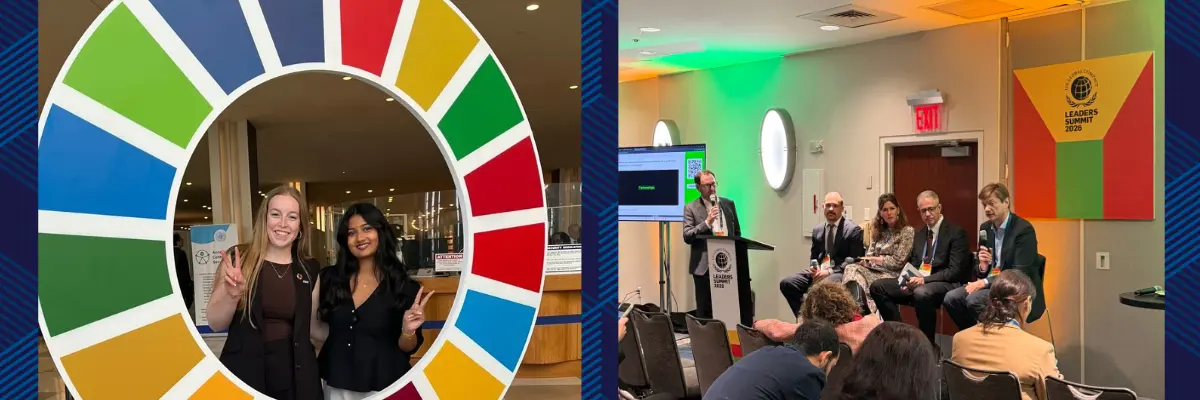
PRME at UNGA81: Connecting Business Education, Finance and Leadership for Systems Change
 Ontario, Canada
Signatory Spotlight: Yorkville University, Canada